Patient-Similarity GNNs for Prostate Cancer Survival Prediction
Overview
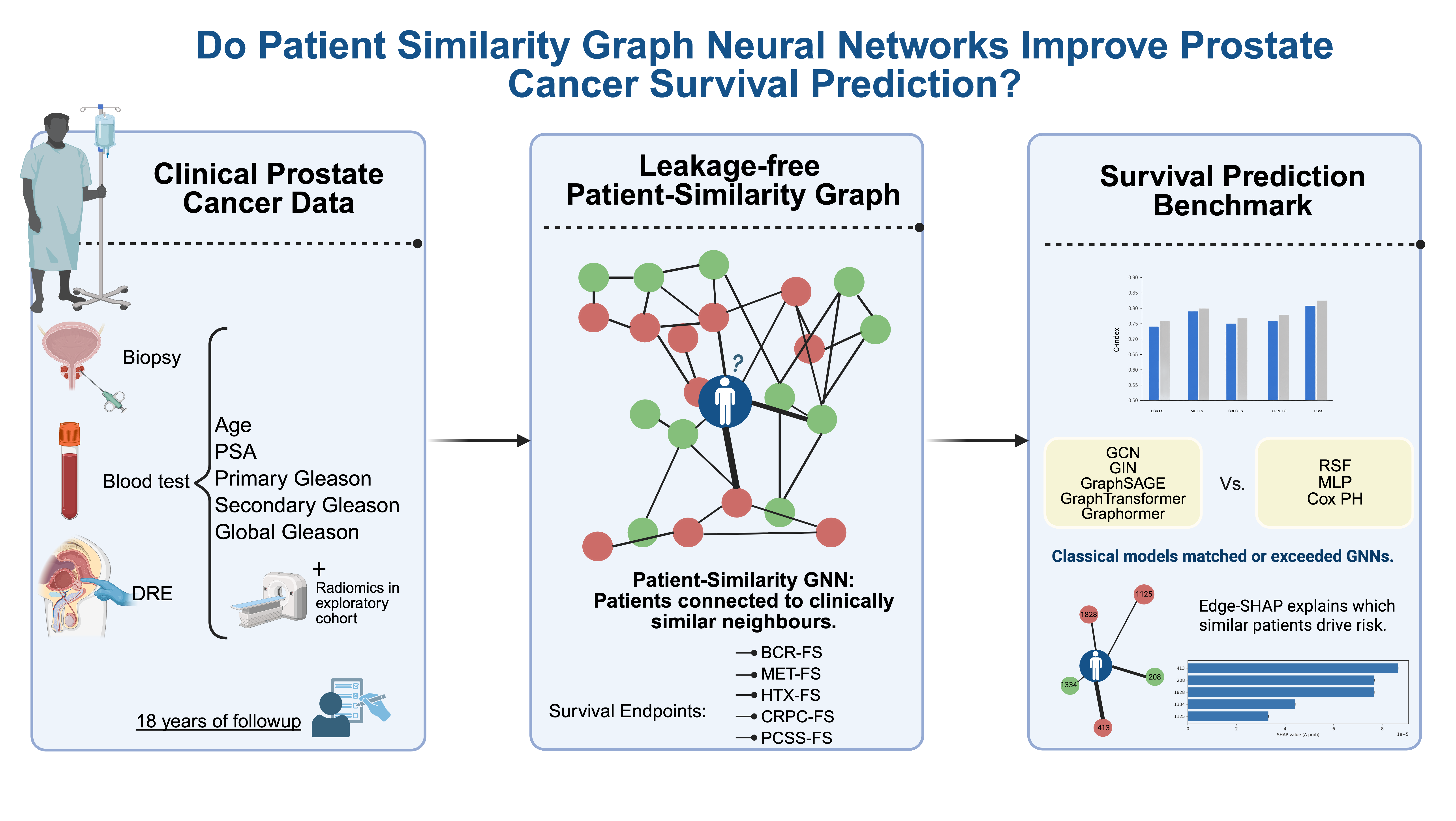
This first-author project investigated whether patient-similarity graph neural networks (GNNs) improve multi-outcome prostate cancer survival prediction compared with well-tuned classical survival models. Patients were represented as nodes in a leakage-free similarity graph constructed from clinical features, enabling the model to learn from clinically similar neighbours. The goal was not only to evaluate predictive performance, but also to examine whether graph-based models offer additional interpretability for clinical prognosis.
My role
I led this project as part of my MSc thesis at Université Laval / CRCHUQ. I designed the study, developed the modeling and evaluation pipelines, implemented the graph-based and baseline models, ran the experiments, performed the statistical and interpretability analyses, created the figures, and prepared the manuscript.
Methods & tools
The project compared multiple patient-similarity GNN architectures (GCN, GraphSAGE, GIN, Graph Transformer, and Graphormer) against classical and deep-learning baselines including Cox proportional hazards, Random Survival Forest, and MLP. The study used leakage-free k-nearest-neighbour graph construction, nested cross-validation, Optuna hyperparameter optimization, and 15-seed deep ensembles. Model interpretation was performed using SHAP at both the feature and neighbour (edge) levels. The implementation was developed in Python using PyTorch, PyTorch Geometric, scikit-learn, and scikit-survival.
Key findings
The study showed that well-tuned classical survival models matched or exceeded the performance of GNNs across the main cohorts and endpoints, indicating that patient-similarity graphs did not provide a clear discriminative advantage in this low-dimensional clinical setting. Among the GNNs, GCN was the most consistent architecture. The main added value of the graph-based approach was interpretability: edge-level SHAP provided patient-level explanations by identifying which clinically similar neighbours contributed most to a given prediction.
Why it matters
This project provides a rigorous and reproducible benchmark for graph-based survival modeling in prostate cancer. It also highlights an important practical message: in some clinical settings, the value of GNNs may lie less in outperforming simpler models and more in offering clinically meaningful, neighbour-based explanations.
Resources
GitHub repository: github.com/Zahra-Khazaei/survival-gnn
Related output
Manuscript under revision
Do Patient Similarity Graph Neural Networks Improve Prostate Cancer Survival Prediction? A Multi-Cohort Benchmark Study
First author · Target journal: Computer Methods and Programs in Biomedicine · Currently under revision with my MSc supervisor, Dr. Louis Archambault.
Earlier related presentation
Graph-Based Patient Stratification with FDG-PET/CT Imaging: Enhancing Prognostic Models in High-Grade Prostate Cancer
Medical Physics, 51(9), 6821–6822, 2024 · Oral presentation, AAPM 66th Annual Meeting · DOI: 10.1002/mp.17395
See all Publications.